2023/6/16
Share to:
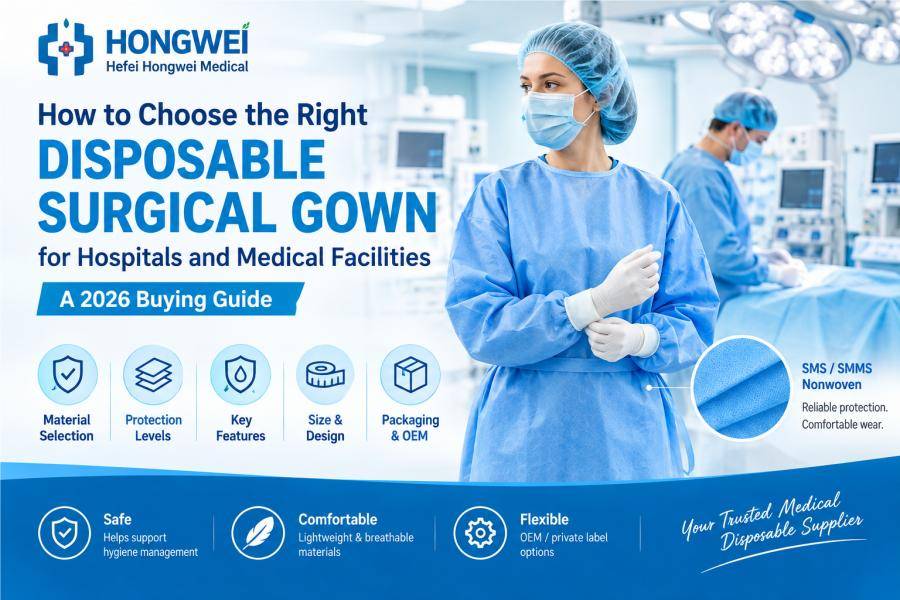
How to Choose the Right Disposable Surgical Gown for Hospitals and Medical Facilities
Choosing the right disposable surgical gown is an important purchasing decision for hospitals, clinics, distributors, and healthcare suppliers. The right gown needs to provide an appropriate level of barrier protection while also allowing healthcare professionals to move comfortably during procedures.
For B2B buyers, selecting a surgical gown should involve more than comparing price and fabric weight. Material construction, barrier performance, critical-zone coverage, sleeve and cuff design, reinforcement, sizing, packaging, documentation, and supplier capability all need to be considered.
This 2026 buying guide explains the key factors global buyers should evaluate when sourcing disposable surgical gowns in bulk.
What Is a Disposable Surgical Gown?
A disposable surgical gown is a single-use protective garment designed for healthcare personnel during surgical procedures. Its purpose is to provide a barrier against contact with microorganisms, body fluids, and particulate matter while supporting the requirements of the procedure.
The U.S. FDA describes surgical gowns as protective garments worn by healthcare personnel during surgical procedures to protect both the patient and healthcare personnel from the transfer of microorganisms, body fluids, and particulate matter.
Unlike reusable surgical gowns, disposable surgical gowns are manufactured for single use and are commonly made from engineered nonwoven materials such as SMS or SMMS.
However, not every disposable medical gown should automatically be classified as a surgical gown. The intended use, barrier performance, labeling, regulatory requirements, and applicable market standards must all be considered.
For hospitals and distributors, this distinction is important when purchasing products for specific procedures.
Why Does Surgical Gown Selection Matter?
Surgical environments can involve different levels of exposure to fluids and contaminants. A gown selected only according to price or GSM may not provide the performance required for a particular procedure.
When evaluating disposable surgical gowns, buyers should consider:
Intended clinical application
Expected fluid exposure
Required barrier level
Fabric construction
Critical-zone protection
Seam construction
Sleeve and cuff design
Reinforcement requirements
Size and range
Comfort and breathability
Packaging and labeling
Applicable regulatory requirements
Supplier quality control
OEM and private-label requirements
The FDA notes that gown selection should be based on the level of protection appropriate for the task or situation, with ANSI/AAMI PB70 providing a classification system based on liquid barrier performance.
1. Start With the Intended Application
The first question buyers should ask is not:
“Which fabric is cheapest?”
Instead, start with:
“What procedure will this gown be used for?”
Different procedures can create different levels of exposure.
For example, a facility may need surgical gowns for:
General surgical procedures
Operating rooms
Invasive procedures
Emergency procedures
Obstetric procedures
Orthopedic procedures
Dental surgery
Veterinary surgery
Other clinical procedures involving potential fluid exposure
The expected amount and duration of fluid exposure should help determine the appropriate barrier performance.
For B2B purchasing, it is useful to define the intended application before requesting quotations. This allows manufacturers to recommend the appropriate combination of material, construction, reinforcement, and protection level.
2. Choose the Right Surgical Gown Material
Material selection has a direct influence on barrier performance, breathability, softness, strength, and cost.
Common materials used for disposable surgical gowns include:
SMS Nonwoven
SMS consists of spunbond, meltblown, and spunbond layers.
It is widely used in medical protective apparel because the material can combine:
Strength
Breathability
Softness
Filtration properties
Barrier performance
SMS is particularly suitable when buyers want a balance between protection and wearer comfort.
SMMS Nonwoven
SMMS adds an additional meltblown layer compared with conventional SMS construction.
Depending on the specification and manufacturing process, this type of multilayer structure can be used when a buyer requires enhanced barrier performance while retaining the characteristics of a nonwoven gown.
However, buyers should not select a material based on its name alone. The final product's tested performance is more important than simply whether the fabric is called SMS or SMMS.
Laminated Nonwoven Materials
Some surgical or protective gown designs use a nonwoven substrate combined with a film layer.
These materials can provide stronger liquid-barrier properties, but they may also affect breathability, flexibility, and wearer comfort.
Therefore, laminated materials should be selected according to the actual exposure risk rather than simply choosing the material with the highest perceived protection.
3. Understand AAMI Protection Levels
For buyers targeting the U.S. market, ANSI/AAMI PB70 is an important reference for evaluating liquid barrier performance.
The current ANSI/AAMI PB70:2022 establishes a classification system for protective apparel and drapes based on barrier performance.
| AAMI Level | General Barrier Performance | Typical Risk Context |
|---|---|---|
| Level 1 | Minimal | Basic care and minimal exposure |
| Level 2 | Low | Procedures involving relatively low fluid exposure |
| Level 3 | Moderate | Higher fluid exposure and procedures requiring increased protection |
| Level 4 | High | High-risk, fluid-intensive situations |
The FDA provides examples ranging from basic care at Level 1 through higher-risk procedures at Levels 3 and 4.
Important: AAMI Level Is Not the Same as GSM
One common purchasing mistake is assuming:
Higher GSM = Higher AAMI Level
This is not necessarily true.
GSM describes the weight of the fabric per square meter. AAMI classification is based on standardized barrier-performance testing.
A 50 GSM material and a 60 GSM material cannot be compared solely by weight to determine which finished gown provides better protection.
For bulk procurement, buyers should request actual test documentation for the finished product or applicable material, rather than relying only on GSM.
4. Pay Attention to the Critical Zones
A surgical gown does not necessarily provide identical protection across every part of the garment.
The design of a surgical gown includes specific areas where barrier protection is particularly important.
According to FDA guidance, the critical protection areas for surgical gowns include the front of the body and the arms from the wrist cuff upward, while the back may have different protection requirements depending on the gown design and applicable standard.
This means buyers should evaluate:
Front panel construction
Sleeve construction
Cuff area
Seam performance
Reinforced zones
Coverage around the torso
Back design
For higher-exposure applications, simply choosing a heavier fabric is not enough. The entire garment construction needs to be appropriate for the intended use.
5. Standard or Reinforced Surgical Gown?
Disposable surgical gowns are commonly available in standard/non-reinforced and reinforced designs.
Non-Reinforced Surgical Gown
A non-reinforced gown may be suitable for procedures where fluid exposure is limited or where additional reinforcement is not required.
Advantages may include:
Lower product cost
Lower weight
Good breathability
Easier movement
Efficient high-volume purchasing
Reinforced Surgical Gown
A reinforced gown adds additional protective material to selected areas that may experience greater exposure.
Common reinforcement areas can include:
Front torso
Sleeves
Other critical zones specified by the product design
Reinforced gowns can therefore be considered when the intended procedure creates greater fluid exposure or requires additional protection in particular areas.
The important point for procurement teams is that reinforcement should be matched to the actual application rather than added simply to increase the product price.
6. Check the Sleeve and Cuff Design
Sleeve construction is often overlooked during purchasing, but it can affect both protection and usability.
A suitable surgical gown should provide:
Adequate sleeve coverage
Comfortable arm movement
Secure cuffs
Compatibility with surgical gloves
Appropriate seam construction
Knitted cuffs are commonly used because they can provide a closer fit around the wrist and help maintain the connection between the gown sleeve and gloves.
When ordering samples, buyers should test the gown with gloves rather than evaluating the cuff separately.
Check whether:
The sleeve remains in position
The cuff stays comfortable
The glove can cover the cuff properly
The sleeve restricts movement
The seam causes discomfort
These practical details can have a significant effect on user acceptance.
7. Check Size and Overall Coverage
A surgical gown that is too small may reduce coverage and restrict movement.
A gown that is excessively large may create unnecessary material around the arms and body.
Hongwei's current disposable surgical gown specification lists:
L: 120 × 140 cm
XL: 130 × 150 cm
XXL: 140 × 160 cm
Customized sizes available
The listed product range also includes 40–70 GSM options and both reinforced and non-reinforced styles.
For distributors, offering multiple sizes can make the product more suitable for different healthcare customers.
When requesting samples, check:
Body length
Sleeve length
Chest coverage
Back coverage
Wrist fit
Ease of movement
Overall drape
For OEM projects, manufacturers should confirm final measurements using a product specification sheet before mass production.
8. Don't Choose a Surgical Gown Based on GSM Alone
GSM is useful when comparing materials, but it should not be the only purchasing parameter.
For example:
40 GSM vs. 60 GSM
does not automatically mean:
lower protection vs. higher protection.
Performance depends on multiple factors, including:
Fiber structure
Number of layers
Material composition
Fabric manufacturing process
Lamination
Seam construction
Reinforcement
Finished garment design
Testing method
Therefore, professional buyers should treat GSM as one specification among several, rather than using it as a substitute for performance testing.
9. Evaluate Seam Construction and Garment Strength
A surgical gown can have suitable fabric but still perform poorly if the garment construction is inconsistent.
During sample evaluation, buyers should examine:
Seams
Check whether seams are:
Evenly constructed
Secure
Consistent
Free from obvious defects
Ties or Closures
Check:
Tie strength
Attachment points
Ease of fastening
Consistency between samples
Cuffs
Check:
Elasticity
Attachment quality
Comfort
Compatibility with gloves
Fabric
Check for:
Holes
Uneven material
Excessive lint
Tears
Contamination
Visible manufacturing defects
For large-volume purchasing, these checks should become part of the supplier's documented quality-control process.
10. Ask for Product Testing and Documentation
This is particularly important for importers and distributors.
A supplier should be able to explain what standards and tests apply to the product being offered.
Depending on the target market and product claims, buyers may need to review documentation related to:
Barrier performance
Material specifications
Physical properties
Product labeling
Sterility, when applicable
Quality management systems
Regulatory compliance
ANSI/AAMI PB70:2022 provides minimum barrier-performance requirements, classification, and labeling requirements for covered protective apparel used in healthcare facilities.
The FDA also notes that surgical gowns are regulated differently from non-surgical gowns in the U.S., so buyers should confirm that the product's intended use and labeling match the applicable regulatory pathway.
A practical supplier document checklist
Before placing a large order, request:
Product specification
Material
GSM
Size
Color
Design
Reinforcement
Cuff type
Testing and compliance
Applicable barrier-performance testing
Test reports
Product compliance documentation
Quality-system certifications where relevant
Commercial documents
Packing specification
Carton dimensions
Net/gross weight
MOQ
Lead time
Shipping terms
11. Sterile or Non-Sterile: Confirm the Requirement
One important purchasing detail is whether the gown is intended to be supplied sterile.
The requirement depends on the intended use and target market.
For example, the FDA states that surgical gowns used as such in the U.S. are required to be provided sterile and labeled as surgical gowns.
For international B2B buyers, the correct approach is to confirm:
Target country
Intended use
Applicable regulatory requirements
Sterility requirement
Sterilization method, if applicable
Packaging requirements
Labeling requirements
Do not assume that a gown described as “medical” or “surgical” automatically has the same regulatory status in every country.
12. Consider Packaging for Bulk Procurement
Packaging can have a major effect on logistics costs and product handling.
Hongwei's current surgical gown listing includes packaging configurations such as:
1 piece/pouch with accessories, 25 pieces/carton
5 pieces/bag, 50 pieces/carton
Customized packaging is also available for OEM projects.
For importers and distributors, compare:
Pieces per inner bag
Pieces per carton
Carton dimensions
Carton weight
Individual packaging requirements
Labeling
Barcode requirements
Private-label packaging
Shipping efficiency
A slightly lower unit price may not result in the lowest landed cost if the packaging configuration creates inefficient carton utilization.
13. OEM and Private Label Surgical Gowns
For distributors and medical supply companies, OEM customization can be important when building a private-label product line.
Potential customization options may include:
Product size
Fabric specification
Color
Reinforcement area
Sleeve style
Cuff design
Packaging
Carton printing
Private label
Product documentation
Hongwei states that it provides OEM services including customized product logos, inner packaging, and cartons.
Before starting an OEM order, buyers should confirm all specifications in writing.
A useful OEM specification sheet should include:
Product: Disposable Surgical Gown
Material: SMS / SMMS / specified material
GSM: Confirmed specification
Size: L / XL / XXL / customized
Style: Reinforced / Non-reinforced
Sleeve: Set-in / Raglan
Cuff: Specified type
Color: Specified color
Packaging: Confirmed packing method
Label: Private label requirements
Testing: Applicable test requirements
Carton: Confirmed carton specification
This reduces misunderstandings between buyer and manufacturer before mass production.
14. How to Evaluate a Surgical Gown Supplier
Choosing the right product is only part of the purchasing process.
For importers and distributors, the supplier's manufacturing and quality-control capability can be equally important.
Before placing an order, evaluate:
Manufacturing Capability
Ask:
Is the company a manufacturer or trading company?
What products does it manufacture?
What is its production capacity?
Can it support repeat orders?
Does it have stable raw-material sourcing?
Quality Management
Check:
Quality-control procedures
Incoming material inspection
Production inspection
Finished-product inspection
Packaging inspection
Product traceability
Customization
Confirm whether the supplier can support:
OEM
Private label
Custom packaging
Custom sizes
Custom specifications
Export Experience
For international buyers, also evaluate:
Export experience
Documentation support
Shipping experience
Communication
Lead-time management
After-sales service
15. Why Choose Hefei Hongwei Medical for Disposable Surgical Gowns?
Hefei Hongwei Medical Devices Co., Ltd. has been supplying disposable medical products since 2008 and operates within the Anhui Guohong Industrial Group manufacturing network. Its product portfolio includes surgical gowns, isolation gowns, scrub suits, disposable face masks, gloves, shoe covers, and other medical disposable products.
For its disposable surgical gown range, Hongwei currently lists SMS/SMMS materials, multiple sizes, 40–70 GSM options, reinforced and non-reinforced styles, and set-in or raglan sleeve designs.
The company also states that it maintains ISO 13485 and ISO 9001 certifications and provides OEM services for customized products and packaging.
For distributors, importers, and healthcare suppliers, this combination allows surgical gowns to be developed according to specific market, packaging, and procurement requirements.
For product specifications, samples, OEM requirements, or bulk quotations, contact Hefei Hongwei Medical directly.
Disposable Surgical Gown Buying Checklist
Before placing a bulk order, buyers can use the following checklist:
| Item | What to Check |
|---|---|
| Intended use | Surgical / invasive / other applicable procedure |
| Material | SMS, SMMS, laminated or specified material |
| GSM | Confirm actual specification |
| Barrier level | Verify required AAMI or applicable standard level |
| Reinforcement | Standard or reinforced |
| Critical zones | Confirm protection areas |
| Sleeve | Set-in or raglan |
| Cuff | Type and glove compatibility |
| Size | L / XL / XXL / customized |
| Color | Confirm color requirement |
| Seams | Construction and quality |
| Packaging | Inner and carton configuration |
| Sterility | Confirm market and application requirement |
| Testing | Request applicable reports |
| Certifications | Verify relevant supplier/product documentation |
| OEM | Logo, packaging and private label |
| MOQ | Confirm before quotation |
| Lead time | Confirm production schedule |
| Shipping | Carton size and weight |
Common Mistakes When Buying Disposable Surgical Gowns
Mistake 1: Choosing the Lowest Price
A low unit price does not necessarily mean the lowest total procurement cost.
Material consistency, product defects, packaging, shipping efficiency, and order reliability all affect the final cost.
Mistake 2: Using GSM as the Only Quality Indicator
GSM describes material weight, not the complete barrier performance of the finished gown.
Mistake 3: Assuming Every SMS Gown Has the Same Performance
Different manufacturers can use different material structures, production processes, and specifications.
Always verify the actual product specification and test documentation.
Mistake 4: Ignoring Reinforcement
For procedures with greater fluid exposure, buyers should evaluate whether reinforced construction is appropriate.
Mistake 5: Buying Without Samples
Before a large order, samples should be evaluated for:
Fit
Comfort
Coverage
Material feel
Cuff design
Seam quality
Packaging
Overall workmanship
Mistake 6: Ignoring the Target Market
Regulatory and labeling requirements can vary by country.
A product suitable for one market may require different documentation, labeling, testing, or sterility arrangements in another.
Final Thoughts
Choosing the right disposable surgical gown requires more than comparing material, GSM, or unit price.
A professional purchasing process should begin with the intended application and required protection level, followed by evaluation of material construction, critical zones, reinforcement, garment design, size, testing, packaging, and supplier capability.
For hospitals, distributors, and international importers, the most reliable approach is to define the technical requirements first and then compare suppliers against the same specification.
This makes it easier to identify a surgical gown that matches the intended application while also supporting consistent quality and efficient bulk procurement.
If you are sourcing disposable surgical gowns in bulk, Hefei Hongwei Medical can provide product specifications, samples, OEM/private-label options, and quotation support for international buyers.
FAQ
What material is commonly used for disposable surgical gowns?
SMS and SMMS nonwoven materials are commonly used because they can combine barrier performance, strength, softness, and breathability. The appropriate material depends on the intended application and required performance.
What GSM is suitable for a surgical gown?
There is no single GSM that is suitable for every surgical application. GSM should be considered together with fabric construction, barrier performance, reinforcement, and the applicable testing requirements.
What is the difference between reinforced and non-reinforced surgical gowns?
A non-reinforced gown uses the base material throughout its main construction, while a reinforced gown adds additional protective material to selected areas where greater barrier performance may be required.
What are AAMI Levels 1–4?
ANSI/AAMI PB70 classifies protective apparel according to liquid barrier performance, with Level 1 representing minimal barrier performance and Level 4 representing the highest classification.
Can surgical gowns be customized?
Yes. Depending on the manufacturer, buyers may customize size, material specification, color, reinforcement, packaging, labeling, and other OEM requirements.
What should I ask a surgical gown manufacturer before ordering?
Ask about material, GSM, barrier performance, testing, sizes, reinforcement, packaging, MOQ, lead time, quality control, certifications, OEM capability, and documentation for your target market.
News Center
Industry News




 WhatsApp
Send us your message
You can send an email asking for the price and detailed information of this product. We will reply you as soon as we receive your email