For hospitals, medical distributors, and healthcare product importers, choosing between
N95 respirators and surgical masks is not simply a matter of price.
Although both products provide respiratory protection, they are designed for different
applications. Surgical masks mainly work as a barrier against droplets and contamination,
while N95 respirators are designed for environments where higher filtration and tighter
protection are required.
For global medical buyers, understanding the differences in filtration performance,
certification requirements, and usage scenarios is essential before selecting a reliable
mask supplier.
Key Takeaway:
Surgical masks are suitable for general medical protection, while N95 respirators are
designed for higher-risk environments requiring stronger respiratory protection.
What Is a Surgical Mask?
A surgical mask is a disposable medical device commonly used in hospitals, clinics,
dental facilities, and healthcare environments.
Its primary purpose is to reduce exposure to respiratory droplets and prevent contamination
between healthcare workers, patients, and the surrounding environment.
A typical surgical mask consists of multiple layers:
Outer layer: Provides basic fluid resistance and protection.
Melt-blown filtration layer: The core filtration material responsible for
particle capture.
Inner layer: Soft non-woven fabric designed for comfort during extended wear.
For medical buyers, product performance depends on several factors including filtration
efficiency, breathability, fluid resistance, and manufacturing consistency.
Common standards used for surgical masks include:
What Is an N95 Respirator?
An N95 respirator is a high-filtration respiratory protective device designed to provide
a tighter seal around the face compared with traditional surgical masks.
The term "N95" means the respirator can filter at least 95% of airborne particles under
NIOSH testing conditions.
Unlike surgical masks, N95 respirators focus not only on filtration materials but also
on minimizing air leakage around the edges.
Key design features include:
High-efficiency filtration media
Adjustable nose clip for better fitting
Secure headband structure
Improved face seal performance
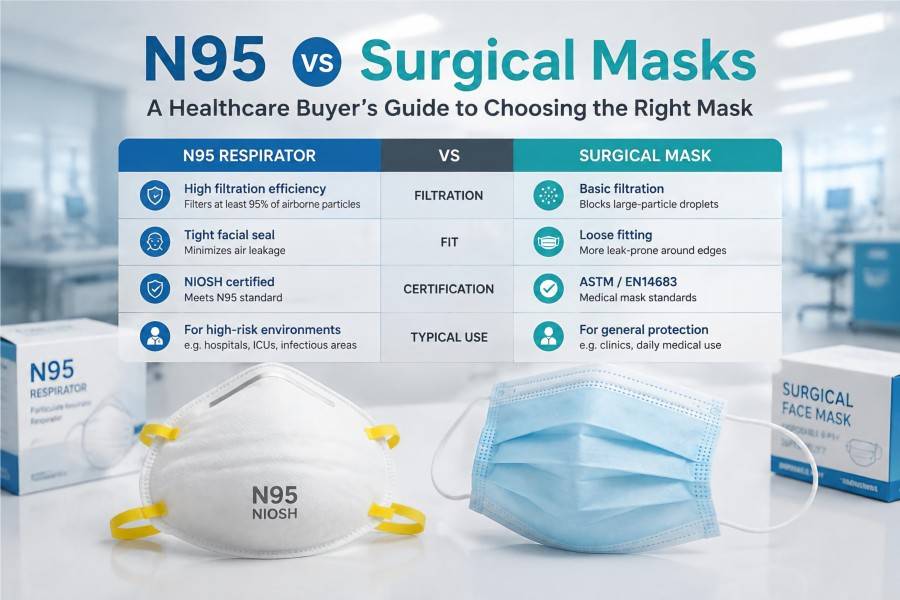
N95 vs Surgical Masks: Key Differences
Understanding the differences between these two products helps healthcare buyers choose
the right solution for different applications.
| Factor | Surgical Mask | N95 Respirator |
|---|
| Primary Purpose | Droplet protection and contamination control | Airborne particle protection |
| Fit | Loose fitting | Tight facial seal |
| Filtration | Medical barrier protection | High-efficiency particle filtration |
| Certification | ASTM F2100 / EN14683 | NIOSH N95 standard |
| Typical Application | General healthcare environments | High-risk medical environments |
Which Mask Should Medical Buyers Choose?
When Surgical Masks Are More Suitable
Surgical masks are commonly selected for routine healthcare applications where basic
barrier protection is required.
For large-volume purchasing, surgical masks are often preferred because they provide a
balance between protection, comfort, and cost efficiency.
When N95 Respirators Are More Suitable
N95 respirators are designed for situations where healthcare workers may face higher
levels of airborne particle exposure.
Emergency medical environments
Infectious disease treatment areas
High-risk procedures
Industrial environments requiring respiratory protection
What Should Medical Importers Check Before Buying Masks?
Choosing the right mask type is only the first step. For hospitals, distributors, and
medical supply companies, selecting a reliable manufacturer is equally important.
Before placing a bulk order, professional buyers should evaluate the following factors:
1. Verify Product Standards and Test Reports
Medical masks should always be supported by proper testing documents. Buyers should not
rely only on product descriptions or supplier claims.
A reliable supplier should be able to provide:
Product test reports
Applicable certification documents
Quality inspection records
Batch consistency information
Before importing medical masks, always confirm that the certificates match the actual
product model being supplied.
2. Evaluate Filtration Materials and Production Quality
The filtration performance of disposable masks depends heavily on raw material quality,
especially the melt-blown filtration layer.
Medical buyers should understand:
What type of filtration material is used
How raw materials are controlled
How filtration efficiency is tested
How production quality is maintained during mass manufacturing
A professional manufacturer should have a stable supply chain for key materials and a
clear quality control process.
3. Check Manufacturing Capability and Supply Stability
For international buyers, supplier capability is not only about product quality.
Production stability and delivery reliability are also critical.
Important questions include:
How many production lines are available?
What is the monthly production capacity?
How does the supplier handle large-volume orders?
Can the supplier support OEM and customized packaging?
4. Confirm Packaging and Customization Requirements
Packaging requirements vary depending on the target market and sales channel.
Medical buyers may need options such as:
Common Mistakes When Importing Disposable Masks
Many importers focus mainly on unit price when sourcing disposable masks. However,
the cheapest option does not always provide the best long-term value.
Mistake 1: Choosing Suppliers Based Only on Price
A lower quotation may indicate differences in raw materials, testing standards, or
production controls.
Professional buyers should evaluate the complete supply capability instead of comparing
only the product price.
Mistake 2: Ignoring Certification Verification
Certificates are important, but buyers should verify whether the documents correspond
to the actual product being purchased.
Working with manufacturers that provide transparent documentation can reduce sourcing risks.
Mistake 3: Treating N95 and Surgical Masks as the Same Product
Although both products are disposable masks, their applications are different.
Selecting the wrong mask type may lead to unnecessary costs or insufficient protection
for the intended environment.
How Honway Med Supports Global Medical Buyers
As a professional disposable medical products manufacturer, Honway Med focuses on
providing reliable supply solutions for healthcare distributors, importers, and
medical organizations worldwide.
Our capabilities include:
Disposable face mask manufacturing
OEM and private label services
Customized packaging solutions
Quality control throughout production
Support for international medical supply chains
For medical distributors, choosing the right supplier is as important as choosing the
right product.
Frequently Asked Questions
Are N95 masks better than surgical masks?
N95 respirators provide higher respiratory protection because they are designed for
higher filtration efficiency and closer facial fitting. Surgical masks are suitable
for general medical protection and droplet control.
Can surgical masks replace N95 respirators?
In high-risk environments requiring airborne particle protection, surgical masks should
not be considered a replacement for N95 respirators.
What certifications should medical mask buyers check?
The required certification depends on the target market. Common standards include ASTM
F2100, EN14683, and NIOSH N95 requirements.
How can importers choose a reliable medical mask manufacturer?
Buyers should evaluate production capability, testing documents, raw material control,
quality management, and experience with international orders.
Looking for a Reliable Disposable Mask Supplier?
Honway Med provides disposable medical mask manufacturing and OEM solutions for global
healthcare distributors and importers.
Contact Honway Med




 WhatsApp
Send us your message
You can send an email asking for the price and detailed information of this product. We will reply you as soon as we receive your email